Showing posts with label Assault rifle/Semi Auto Rifle. Show all posts

Wednesday, August 28, 2013

OFB-INSAS Rifle

OFB-INSAS Rifle


INSAS (an abbreviation of Indian Small Arms System) is a family of infantry arms consisting of an assault rifle, a light machine gun and a carbine. It is manufactured by the Ordnance Factories Board at Ordnance Factory Tiruchirappalli, Small Arms Factory Kanpur and Ishapore Rifle Factory. The Insas Assault Rifle is the standard infantry weapon of the Indian Armed Forces.

Insas rifle system has been a very effective low cost solution that utilized the best to offer from three rifle systems, viz. AK47, FN FAL, and the M16.

The action, long stroke gas system, rotating bolt, and stamped steel receiver gives it the ruggedness and reliability of an AK47, the Gas regulator from the FAL give it the ability to cycle rounds, even if the rifle’s gas piston is clogged. Although It has a stamped receiver, the tolerances are kept significantly tight along with the lesser reciprocating breach axis offset compared to AK, gives it reliable accuracy.


Although 5.56x 45 Nato attracts a lot of flak from critics, it is the most flat shooting round upto 300 yards, and is effective up to 600 yards. Although 7.62 x 39, the AK round has better terminal ballistics, the rounds justs drops too much. When 7.62 x 39 is zeroed at 100 yards, the compensation at 400 yards is nearly 60 inches making the target nearly disappear from the sight picture( which is the engagement range for IA positions in LOC), With a 5.56 you will have to compensate lesser, but compromise on terminal ballistics which a fair tradeoff, as you are hitting the target (if not completely neutralizing him).

Insas is controllable in full auto like the m16, whereas FAL becomes an ack ack in full auto and with and  ak47  "you spray and pray". When the Insas was introduced, there was no 6.8 SPC or the 6.5 grendel options hence 5.56 was lesser of evil when it came to developing a battle rifle.All these mix and match features gave you a reliable, low cost, accurate rifle borrowing on best features of contemporaries and minimizing drawbacks of the each mentioned systems.


Cartridge    5.56x45mm INSAS
5.56x45mm NATO
5.56×30mm MINSAS
Action            Gas-operated, Rotating bolt
Rate of fire            650 rounds/min
Muzzle velocity    900 m/s (2,953 ft/s)
Effective range    450 Meters
Feed system    20/30-round detachable box magazine
Sights            In-built Iron sights
                        Plate for attaching various scopes made by Ordnance Factory Board


Tuesday, August 27, 2013

The Bullpups

The Bullpups 


"Bullpup" describes a modern firearm configuration in which the action is located behind the trigger group and alongside the shooter's face, so there is no wasted space for the buttstock as in conventional designs. This permits a shorter firearm length for the same barrel length for improved maneuverability, and reduces weight.

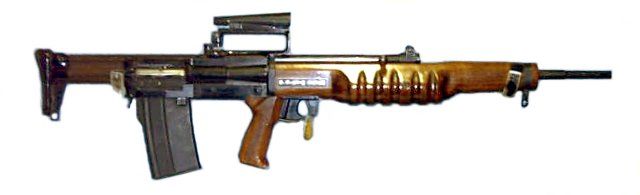
The Grandpa Bullpup- The EM-2,


Also known as Rifle No.9 Mk1 or "Janson rifle", was an experimental British assault rifle. It was briefly adopted by British forces in 1951, but the decision was overturned very shortly thereafter by Winston Churchill's incoming government in an effort to secure NATO standardization of small arms and ammunition in the face of American intransigence. An innovative weapon with the compact bullpup layout and an optical sight, it used one of the early intermediate cartridges


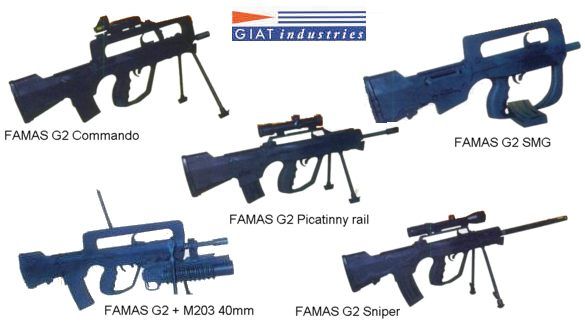
French FAMAS


The FAMAS (French: Fusil d'Assaut de la Manufacture d'Armes de Saint-Étienne or "Assault rifle of the Saint-Étienne weapon factory") is a bullpup-styled assault rifle designed and manufactured in France by MAS located in Saint-Étienne, which is now a member of the French government-owned Nexter group. It is the service rifle of the French military.


The Austrian  Steyr AUG


The Steyr AUG (1977) is often cited as the first successful bullpup, finding service with the armed forces of over twenty countries, and becoming the primary rifle of Austria and Australia. It was highly advanced for the 1970s, combining in the same weapon the bullpup configuration, a polymer housing, dual vertical grips, an optical sight as standard, and a modular design. Highly reliable, light, and accurate, the Steyr AUG showed clearly the potential of the bullpup layout.

The British SA80


The SA80 (Small Arms for the 1980s) is a British family of 5.56mm small arms. It is a selective fire, gas-operated assault rifle. SA80 prototypes were trialled in 1976 and production was completed in 1994.
The L85 rifle variant of the SA80 family has been the standard issue service rifle of the British Armed Forces since 1987, replacing the L1A1 variant of the FN FAL. The improved L85A2 remains in service today. The remainder of the family comprises the L86 Light Support Weapon, the short-barrelled L22 carbine and the L98 Cadet rifle.
The SA80 was the last in a long line of British weapons (including the Lee-Enfield family) to come from the national arms development and production facility at Enfield Lock. Its bullpup configuration stems from a late-1940s programme at Royal Small Arms Factory Enfield to design a new service rifle known as the EM-2, which though similar in outline, was an entirely different weapon. The EM-2 was an advanced bullpup configuration rifle, which despite good performance and being officially adopted by the British Army in 1951, never entered service.

The Israeli Tavor TAR 21


The TAR-21 (or simply Tavor) is an Israeli bullpup assault rifle chambered for 5.56×45mm NATO ammunition with a selective fire system, selecting between semi-automatic mode and full automatic fire mode. It is named after Mount Tabor, while "TAR-21" stands for "Tavor Assault Rifle – 21st Century". Since 2009, it has been selected as the standard issued weapon of the Israeli infantry. The MTAR-21 (Micro Tavor) was recently selected as the future assault rifle of the Israeli Defense Forces, and some infantry division are being issued with the rifle, replacing the bigger and standard TAR-21.

Modular Combat Rifles

Modular Combat Rifles


Bushmaster  - ACR - Adaptive Combat Rifle


This rifle in my opinion is the real successor to the Eugene Stoner's M16, most may disagree but the rifle that started out as the Magpul Masada envisioned exceptional modularity, adaptivity and reliability that would have made Mr Stoner proud. Having shot the ACR semi auto, the feel of the rifle is exceptionally close to the AR platform ergonomics. Chris Costa, was heavily involved in the concept for the masada, and it shows in the design, this is a highly functional design and has some features that would make Spec ops teams around the world happy campers, although this product had a recall, I am under the impression that the kinks have been ironed out. This rifle was primarily designed for 5.5 and the 7.62 x 39, for some reason the 7.62 x 39 was dropped by the Bushmaster co and instead 6.8SPC was selected. ACR, the true heir to the M16 is destined to be a world beater (in the ideal world)


FN SCAR


FN SCAR-  Welcome to MK-MOD world...most firearms with Mod xx mkxx in US/Nato nomenclature end up with special forces, and this Rifle produced in two configurations is just that, Special Operations Forces Combat Assault Rifle (SCAR)!!!! FN Herstal initially was on the same bandwagon as the magpul guys and wanted to create a modular system with 5.56 Nato, 7.62 Nato, 7.62 x 39, 6.8 SPC and 6.5 grendel (unconfirmed), for probably the same reasons as bushmaster they decided the final product to just have 5.56 Nato and 7.62x51 nato calibers.  The rifle uses a M1 like gas system and fires from a closed bolt atleast for the semi auto version, the version submitted for the USMC stuff was slightly different and used a innovative hybrid bolt system.
In all this system was envisaged for the spec op forces and will trickle down the chain eventually for spec ops, but seems like it still doesn't have what it takes for being accepted as the main battle rifle.

Beretta ARX 160


One of the most anticipated rifles in the lineups and competing to be the next infantry rifle for the Indian Army/ IAR US-Army (cancelled) and in service with more than 5 Armies around the world, is true adaptive combat rifle system. Chambered in 7.62 x 39, 5.56 nato, 5.45 x 39, 6.8 SPC. This is a rifle to watch out for, this might be the next big thing. The system capitalizes on ergonomics, reliability and modularity, three traits desired by the most modern armies providing the flexibility of calibers and roles of the modern gunners, essentially a brute force multiplier.

Heckler And Koch G-3

Heckler And Koch G-3


The G3A3 (A4) is a selective-fire automatic weapon that employs a roller-delayed blowback operating system. The two-piece bolt assembly consists of a breech (bolt head) and bolt carrier. The bolt is held in battery by two sliding cylindrical rollers that engage locking recesses in the barrel extension (popularly called a "trunnion"; BATF calls this a "mounting block"). The breech is opened when both rollers are compressed inward against camming surfaces driven by the rearward pressure of the expanding gases upon the bolt head. As the rollers move inward, recoil energy is transferred to the locking piece and bolt carrier which begin to withdraw while the bolt head slowly moves rearward in relation to the bolt carrier. As the bolt carrier clears the rollers, pressure in the bore drops to a safe level, the bolt head is caught by the bolt carrier and moves to the rear as one unit, continuing the operating cycle. The bolt also features an anti-bounce mechanism that prevents the bolt from bouncing off the barrel's breech surface. The spring-powered claw extractor is also contained inside the bolt while the lever ejector is located inside the trigger housing (actuated by the recoiling bolt)


The rifle is hammer fired and has a trigger mechanism with a 3-position fire selector switch that is also the manual safety toggle that secures the weapon from accidentally discharging (fire selector in the “E” or “1” position – single fire mode ("Einzelfeuer"), “F” or “20” – automatic fire ("Feuerstoß"), “S” or “0” – weapon is safe ("Sicher"), trigger disabled mechanically). The weapon can be fitted with an optional 4-position safety/fire selector group illustrated with pictograms with an ambidextrous selector lever. The additional, fourth selector setting enables a 3-round burst mode of fire.


The firearm was equipped with iron sights that consist of a rotary rear drum and hooded front post. The rear sight, mechanically adjustable for both windage and elevation, has an open notch used to fire up to 100 m and three apertures used for: 200, 300 and 400 m. The receiver housing has recesses that work with HK clamp adapters used to mount day or night optics.


Specifications

Cartridge    7.62×51mm NATO
Action    Roller-delayed blowback
Rate of fire    500–600 rounds/min
Muzzle velocity    800 m/s (2,625 ft/s)
Effective range    500 metres (550 yd), 100–400 m sight adjustments
Feed system    20-round detachable box and 50-round drum magazine
Sights    Rear: rotary diopter; front: hooded post[/QUOTE]

AR15 M16 Platform


Semi Auto AR15 


AR 15/M16 Variants

The AR-15 is a lightweight, 5.56 mm, magazine-fed, semi-automatic rifle, with a rotating-lock bolt, actuated by direct impingement gas operation or long/short stroke piston operation. It is manufactured with the extensive use of aluminum alloys and synthetic materials.


Specifications:
Action:               Gas-operated, rotating bolt (direct impingement)
Prominent Calibers:  5.56 x 45 Nato/ .223 Rem
Popular Calibers:     5.56 nato, .22 LR, 7.62 X 39, 6.5mm Grendel, 6.8 mm Remington SPC, calibers    
                            supported exist in the range of everything from .177HMR to .50 cal.
Operational Range:  600 yards
Rate of fire:           12–15 rounds/min sustained
                           45–60 rounds/min semi-automatic
                           700–950 rounds/min cyclic
Muzzle velocity:        715 m/s (2,350 ft/s)
Feed system:        30 round Stanag, 50/100 round drum bags, 50 round box mags.

Variants include but not limited to AR15 semi auto, M4 carbine, Colt M16, LWRC M6A1 Larue OBR, DPMS AR 15, Delton AR etc.


FN FAL

FN FAL


The Phrase "Help I've Fallen" got a new definition when the FN FAL arrived. Didn't matter what odds were against you when you had the biggest baddest boy of assualt rifle world on your shoulders. Unlike the AK and AR, the FAL used a s big 7.62 x 51 full size rifle cartridge. The FAL was predominantly chambered for the 7.62×51mm NATO round, and because of its prevalence and widespread use among the armed forces of many NATO countries during the Cold War it was nicknamed "The right arm of the Free World"

The FAL operates by means of a gas-operated action very similar to that of the Russian SVT-40. The gas system is driven by a short-stroke, spring-loaded piston housed above the barrel, and the locking mechanism is what is known as a tilting breechblock. To lock, it drops down into a solid shoulder of metal in the heavy receiver much like the bolts of the Russian SKS carbine and French MAS-49 series of semi-automatic rifles. The gas system is fitted with a gas regulator behind the front sight base, allowing adjustment of the gas system in response to environmental conditions. The piston system can be bypassed completely, using the gas plug, to allow for the firing of rifle grenades and manual. The FAL's magazine capacity ranges from five to 30 rounds, with most magazines holding 20 rounds. In fixed stock versions of the FAL, the recoil spring is housed in the stock, while in folding-stock versions it is housed in the receiver cover, necessitating a slightly different receiver cover, recoil spring, and bolt carrier, and a modified lower receiver for the stock.


Specification:

Cartridge:     7.62×51mm NATO
Action:     Gas-operated, tilting breechblock
Rate of fire: 650–700 rounds/min
Muzzle velocity   
FAL 50.00: 840 m/s (2,756 ft/s)
FAL 50.61: 840 m/s (2,755.9 ft/s)
FAL 50.63: 810 m/s (2,657.5 ft/s)
FAL 50.41: 840 m/s (2,755.9 ft/s)
Feed system    20 or 30-round detachable box magazine. 50 round drum also available.
Range : 800 Yards effective(optics), 400-600 iron sights.


AK 47 The Avtomat Kalashnikova of 1947 


The innovation of the injured tank commander, Mikhail Kalashnikov became the go to gun for revolutionaries, mercenaries and armies all across the globe. Considered the most reliable firearm of all time, always associated to (but not limited to)  the 7.62 x 39 mm cartridge, the gun has seen conflict in every part of the world.


Specifications:
Action:    Gas-operated, rotating bolt
Rate of fire:    Cyclic rate of fire is 600 rounds/min
Semi Auto : 40 rounds/ min
Muzzle velocity:    715 m/s (2,350 ft/s)
Effective range:    350 metres (380 yd)
Feed system:    Standard magazine capacity is 30 rounds. There are also 10, 20, 40, 75, or 100-
                        round detachable box and drum style magazines


Variants: AK 47, AKM, AK74, AK-101/AK-102 series, AK-103/AK-104 series, AK-107/AK-108 series
AK-12, Saiga Shotgun, Saiga Hunting Semi auto variant, Wasr 10, Type 56 assault rifle, R4 assault rifle, RK 62, RK 95 TP, PM md. 63/65/86/90, Draco Pistol,

Derivatives

The basic design of the AK-47 has been used as the basis for other successful rifle designs such as the Finnish Rk 62/76 and Rk 95 Tp, the Israeli Galil, the Indian INSAS and the Yugoslav Zastava M76 and M77/82 rifles. Several bullpup designs have surfaced such as the Chinese Norinco Type 86S, although none have been produced in quantity. Bullpup conversions are also available commercially.